Marijuana And the Brain
by John Gettman
High Times, March, 1995
In 1970, marijuana was placed on Schedule 1 of the Drug Enforcement Administration's controlled-substances list, largely because scientists feared that, like opiates, it had an extremely high potential for abuse and addiction. But the discovery of THC receptor sites in the brain refutes that thinking, and may force both scientists and the DEA to re-evaluate their positions.
Introduction
The next century will view the 1988 discovery of the THC receptor site in the brain as the pivotal event which led to the legalization of marijuana. Before this discovery, no one knew for sure just how the psychoactive chemical in marijuana worked on the brain. Throughout the 1970s and 1980s, researchers made tremendous strides in understanding how the brain works, by using receptor sites as switches which respond to various chemicals by regulating brain and body functions. The dominant fear about marijuana in the 20th century has been that its effects were somehow similar to the dangerously addictive effects of opiates such as morphine and heroin. Despite widespread decriminalization of marijuana in the United States in the 1970s, this concern has remained the basis for federal law and policies regarding the use and study of marijuana. The legal manifestation of this fear is the continued classification of marijuana as a Schedule I drug, a category shared by heroin and other drugs that are banned from medical use because of their dangerous, addictive qualities. While only 11 states have formally decriminalized possession of small amounts of marijuana, 45 states distinguish between marijuana and other Schedule I drugs for law-enforcement and sentencing purposes. Until the 1980s, technological limitations obstructed scientific understanding of the neuropharmacology of THC, of how the active ingredient in marijuana actually affects brain functions. Observations and conclusions about this subject, though based on some biological studies, were largely influenced by observations of behavior. This has allowed cultural prejudice to sustain the faith that marijuana is somehow related to heroin, and that research will eventually prove this hypothesis. Actually, the discovery of the THC receptor site and the subsequent research and observations it has inspired conclusively refute the hypothesis that marijuana is dope. Many important brain functions which affect human behavior involve the neurotransmitter dopamine. Serious drugs of abuse, such as heroin and cocaine, interfere with the brain's use of dopamine in manners that can seriously alter an individual's behavior. A drug's ability to affect the neural systems related to dopamine production has now become the defining characteristic of drugs with serious abuse potential.
According to the congressional Office of Technology Assessment, research over the last 10 years has proved that marijuana has no effect on dopamine-related brain systems - unless you are an inbred Lewis rat (see below), in which case abstention is recommended. The discovery of a previously unknown system of cannabinoid neural transmitters is profound. While century-old questions, such as why marijuana is nontoxic, are finally being answered, new, fascinating questions are emerging - as in the case of all great discoveries. In the words of Israeli researcher Raphael Mechoulam, the man who first isolated the structure of THC, "Why do we have cannabinoid receptors?" Mechoulam's theory will resonate well with marijuana smokers in the United States. He observes that "Cannabis is used by man not for its actions on memory of movement or movement coordination, but for its actions on memory and emotions," and asks, "Is it possible that the main task of cannabinoid receptors . . . (is) to modify our emotions, to serve as the links which transmit or transform or translate objective or subjective events into perceptions and emotions?" At a 1990 conference on cannabinoid research in Crete, Mechoulam concluded his remarks by saying, "Let us hope, however, that through better understanding of cannabis chemistry in the brain, we may also approach the chemistry of emotions."
A BRIEF HISTORY OF THC RESEARCH
The receptor breakthrough occurred in 1988 at the St. Louis University Medical School where Allyn Howlett, William Devane and their associates identified and characterized a cannabinoid receptor in a rat brain. The breakthrough has a long history leading up to it. Major figures in American and British organic chemistry, such as Roger Adams, Alex Todd and Sigmund Loewe, did important work in determining the pharmacology of cannabis in the 1940s and 1950s, but their work ground to a halt due to the disinterest cultivated by the 1937 federal ban on marijuana. While synthetic compounds were created which were close to the actual compound, THC, they were not equivalent to it. The structure of one related chemical, cannabidiol, was determined. After repeating the isolation of cannabidiol, in 1963 Mechoulam began work with Yehiel Gaoni that led to the determination of the biosynthetic pathway by which the plant synthesizes cannabinoids. In 1964 Gaoni and Mechoulam isolated tetrahydrocannabinol (THC) and a few years later they reported the first synthesis of THC. Following the identification of the active constituent in marijuana, scientific research began to fill in the gaps and build on Mechoulam's initial breakthrough. The neutral and acidic cannabinoids in cannabis were isolated, and their structures were elucidated. The absolute configurations were determined, as was a reasonable scheme of biogenesis. Total synthesis of the chemical was obtained, and the structure-activity relationship was established. These developments laid the foundation for pharmacological research involving animals and man. This work, along with observations of marijuana's therapeutic applications, opened up investigation into the medical properties of cannabinoids in general and THC in particular. Medical research into the health effects of cannabis also matured throughout this period. In a comprehensive 1986 article in the Pharmacological Review, Leo Hollister of the Stanford University School of Medicine concluded that "compared with other licit social drugs, such as alcohol, tobacco and caffeine, marijuana does not pose greater risks." Hollister wondered if these currently licit drugs would have enjoyed their popular acceptance based on our current knowledge of them. Nonetheless, it has been widely held throughout the 1980s, as Hollister concluded, that "Marijuana may prove to have greater therapeutic potential than these other social drugs, but many questions still need to be answered." The primary question, though, was how do cannabinoids work on the brain? By 1986, scientists were already on the slippery slope that would lead to the discovery of the cannabinoid receptor. The triennial reports from the National Institute on Drug Abuse summarizing research on marijuana had begun to omit references to research on marijuana-related brain damage and instead focus on brain receptor research. A comprehensive article by Renee Wert and Michael Raoulin was published in the International Journal of the Addictions that year, detailing the flaws in all previous studies that claimed to show brain damage resulting from marijuana use. As Hollister independently concluded, "Brain damage has not been proved." The reason, obviously, is that the brain was prepared in some respects to process THC. Also in 1986, Mechoulam put together a book reviewing this research, Cannabinoids as Therapeutic Agents (CRC Press, Boca Raton, FL). One promising area of research was the use of cannabinoids as analgesics or painkillers. A synthetic cannabinoid named CP 55,940, 10-100 times more potent than THC, was also developed in 1986; this was the key to the cannabinoid receptor breakthrough. Receptors are binding sites for chemicals in the brain, chemicals that instruct brain cells to start, stop or otherwise regulate various brain and body functions. The chemicals which trigger receptors are known as neurotransmitters. The brain's resident neurotransmitters are known as endogenous ligands. In many instances, drugs mimic these natural chemicals working in the brain. Scientists are just now confirming their determinations as to which endogenous ligands work on the cannabinoid receptors; it is likely that the neurotransmitter which naturally triggers cannabinoid receptors is one known as anandamide. Research continues. To grossly oversimplify the research involved, a receptor is determined by exposing brain tissue to various chemicals and observing if any of them uniquely bind to the tissue. The search for a cannabinoid receptor depended on the use of a potent synthetic that would allow observation of the binding. CP 55,940 provided this potency, and it allowed Howlett, Devane and their associates, working with tissue from a rat brain, to fulfill precise scientific criteria for determining the existence of a pharmacologically-distinct cannabinoid in brain tissue. A year later the localization of cannabinoid receptors in human brains and other species was determined by scientists at the National Institute of Mental Health, led by Miles Herkenham and including Ross Johnson and Lawrence Melvin, who had worked with Howlett and Devane on the earlier study.
RECEPTORS IN THE BRAIN
The locations of the cannabinoid receptors are most revealing of the way THC acts on the brain, but the importance of this determination is best understood in comparison with the effects of other drugs on the brain. Neurons are brain cells which process information. Neurotransmitter chemicals enable them to communicate with each other by their release into the gap between the neurons. This gap is called the synapse. Receptors are actually proteins in neurons which are specific to neurotransmitters, and which turn various cellular mechanisms on or off. Neurons can have thousands of receptors for different neurotransmitters, causing any neurotransmitter to have diverse effects in the brain. Drugs affect the production, release or re-uptake (a regulating mechanism) of various neurotransmitters. They also mimic or block actions of neurotransmitters, and can interfere with or enhance the mechanisms associated with the receptor. Dopamine is a neurotransmitter which is associated with extremely pleasurable sensations, so that the neural systems which trigger dopamine release are known as the "brain reward system." The key part of this system is identified as the mesocorticolimbic pathway, which links the dopamine-production area with the nucleus of accumbens in the limbic system, an area of the brain which is associated with the control of emotion and behavior. Cocaine, for example, blocks the re-uptake of dopamine so that the brain, lacking biofeedback, keeps on producing it. Amphetamines also block the re-uptake of dopamine, and stimulate additional production and release of it. Opiates activate neural pathways that increase dopamine production by mimicking opioid-peptide neurotransmitters which increase dopamine activity in the ventral tegmental area of the brain where the neurotransmitter originates. Opiates work on three receptor sites, and in effect restrain an inhibitory amino acid, gamma-aminobutyric acid, that otherwise would slow down or halt dopamine production. All of these substances can produce strong reinforcing properties that can seriously influence behavior. The rewarding properties of dopamine are what accounts for animal studies in which animals will forgo food and drink or willingly experience electric shocks in order to stimulate the brain reward system. It is now widely held that drugs of abuse directly or indirectly affect the brain reward system. The key clinical test of whether a substance is a drug of abuse potential or not is whether administration of the drug reduces the amount of electrical stimulation needed to produce self-stimulation response, or dopamine production. This is an indication that a drug has reinforcing properties, and that an individual's use of the drug can lead to addictive and other harmful behavior. To be precise, according to the Office of Technological Assessment (OTA): "The capacity to produce reinforcing effects is essential to any drug with significant abuse potential." Marijuana should no longer be considered a serious drug abuse because, as summarized by the OTA: "Animals will not self-administer THC in controlled studies . . . . Cannabinoids generally do not lower the threshold needed to get animals to self-stimulate the brain regard system, as do other drugs of abuse." Marijuana does not produce reinforcing effects. The definitive experiment which measures drug-induced dopamine production utilizes microdialysis is live, freely-moving rats. Brain microdialysis has proven that opiates, cocaine, amphetamines, nicotine and alcohol all affect dopamine production, whereas marijuana does not. This latest research confirms and explains Hollister's 1986 conclusion about cannabis and addiction: "Physical dependence is rarely encountered in the usual patterns, despite some degree of tolerance that may develop." Most important, the discoveries of Howlett and Devane, Herkenham and their associates demonstrate that the cannabinoid receptors do not influence the dopamine reward system.
CANNABINOID RECEPTORS Research has enabled scientists to know which portions of the brain control various body functions, and this knowledge has been used to explain the pharmacological properties of drugs that activate receptor sites in the brain. There is a dense concentration of cannabinoid binding sites in the basal ganglia and the cerebellum of the base-brain, both of which affect movement and coordination. This discovery will aid in determining the actual physical mechanism by which THC affects spasticity and provides therapeutic benefits to patients with multiple sclerosis and other spastic disorders. While there are cannabinoid receptors in the ventromedial striatum and basal ganglia which are areas associated with dopamine production, no cannabinoid receptors have been found in dopamine-producing neurons, and as mentioned above, no reinforcing properties have been demonstrated in animal studies. There is one study by Gardner and Lowinson, involving inbred Lewis rats, in which doses of THC lowered the amount of electrical stimulation required to trigger the brain reward system. However, no one has been able to replicate the results with any other species of rat, or any other animal. The finding is believed to be the result of some inbred genetic variation in the inbred species, and is both widely mentioned in the literature and disregarded. According to Herkenham and his associates, "There are virtually no reports of fatal cannabis overdose in humans. The safety reflects the paucity of receptors in medullary nuclei that mediate respiratory and cardiovascular functions." This is also why cannabinoids have great promise as analgesics or painkillers, in that they do not depress the function of the heart or the lungs. In this respect, they are far superior to opiates, which decrease the entire physiological system because the receptors are all over the medulla as well as the brain. Marijuana is distinguished from most other illicit drugs by the locations of its brain-receptor sites for two predominant reasons: (1) The lack of receptors in the medulla significantly reduces the possibility of accidental, or even deliberate, death from THC, and (2) the lack of receptors in the mesocorticolimbic pathway significantly reduces the risks of addiction and serious physical dependence. As a therapeutic drug, these features are God's greatest gifts.
THE CHEMISTRY OF EMOTIONS
Mechoulam regrets that more has not been done in the therapeutic application of THC. In a 1986 interview with the International Journal of the Addictions, he said that, "Knowing what I know today, I would have worked more on the therapeutic aspects of cannabis. This area apparently needs a major push that is has not had up till now, particularly given that it has a therapeutic potential. One of the reasons that it has not been pushed was than most pharmaceutical companies years ago were afraid to get into that field. Companies were 'burnt' working on amphetamines and LSD. . . . They are afraid of notoriety." Clearly, cannabis acts on coordination of movement by way of the receptors in the cerebellum and basal ganglia, and on memory by way of the receptors in the limbic system's hippocampus, which "gates" information during memory consolidation. Mechoulam believes that in humans these actions "are rather marginal." "Cannabis," he states, "is used . . . for its actions on mood and emotion." The key to understanding the reason for the presence of cannabinoid receptors in the human brain lies in understanding the role of the receptors in the limbic system, which has a central role in the mechanisms which govern behavior and emotions. The limbic system coordinates activities between the visceral base-brain and the rest of the nervous system. "We know next to nothing on the chemistry of emotions," Mechoulam instructs. It is his hope that future research on the role of cannabinoid receptors in the brain will shed light on this new area of investigation and reflection.
THE FUTURE OF MARIJUANA LAWS
Advances in neurobiology are redefining the scientific basis for addiction. These advances have important ramifications for addiction treatment, and for the treatment of numerous organic diseases and conditions. More importantly for marijuana users, these advances in neurobiology will ultimately force changes in the law. The law is constantly being modified in response to technological changes. The passage of the Controlled Substances Act in 1972 was in part due to a greater understanding of drug abuse brought about by the medical research of the time. The law instituted a policy by which regulation and criminal penalties regarding controlled substances were to be correlated with the harmfulness of the substance. Specifically, the law lists the "actual or relative potential for abuse" as the first matter to be considered in determining the appropriate scheduling of a drug. Schedule I is for drugs which have a "high potential for abuse." While the scheduling of marijuana and its subsequent availability for research and medical use was the subject of a 22-year unsuccessful court battle spearheaded by the National Organization for the Reform of Marijuana Laws, the question of marijuana's abuse potential was never addressed during the litigation and related proceedings. The suit over medical marijuana sought to reschedule marijuana as a Schedule II drug, which also implies a "high potential for abuse." This made the abuse question irrelevant to the court proceedings. However, the abuse question is the pre-eminent issue in attempts to reform marijuana laws, and it is the weak link upon which the entirety of marijuana prohibition rests. The most recent research indicates that marijuana does not have a high potential for abuse, especially relative to other scheduled drugs such as heroin, cocaine, sedatives and amphetamines. The medical-marijuana petition was rejected by the administrator of the DEA because of the lack of scientific studies detailing marijuana's medical value. The court appeal essentially concerned whether or not this was a reasonable standard in light of the government's historic disinterest in funding such studies. While courts have ruled that DEA can rely on research studies, or the lack thereof, in its decision-making about the scheduling of marijuana, they have not ruled on the actual issues which determine the proper legal scheduling of marijuana. The discovery of cannabinoid receptor sites, and their relevance to the understanding of the pharmacology of THC in the brain, provides the basis for a new challenge to the legitimacy of marijuana's Schedule I status, a pivotal event in marijuana's eventual legalization.
Link
01 September 2011
29 July 2011
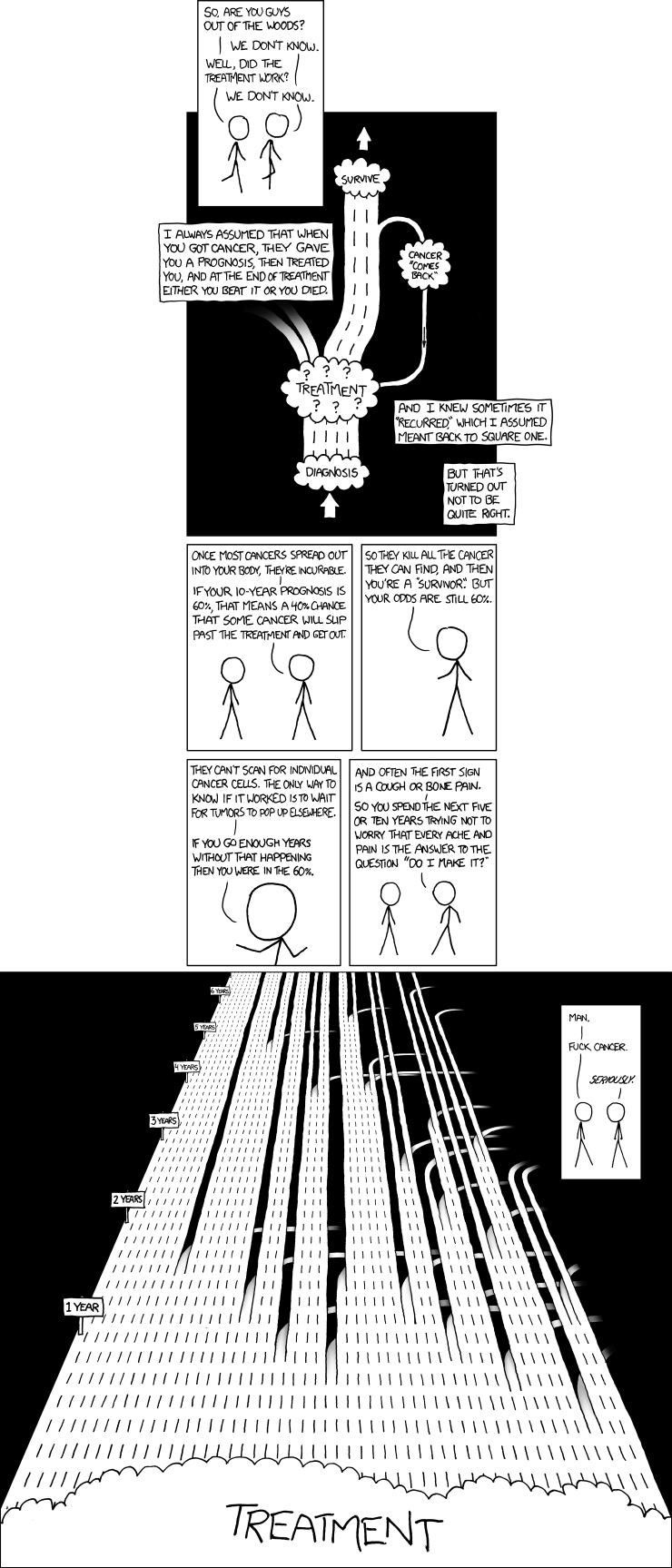
What cancer survival really means
I was really taken aback by this explanation of what cancer survival really means. I know that some of you are fighting cancer* or have someone in your lives who is. This may be useful.
----
*Reflecting on this, I think I see a bit better why some say that 'fighting cancer' is the wrong language/metaphor. Though I'm not sure what to use instead. Help me out.
xkcd: Lanes
(Click to make bigger)
----
*Reflecting on this, I think I see a bit better why some say that 'fighting cancer' is the wrong language/metaphor. Though I'm not sure what to use instead. Help me out.


19 July 2011
Foolproof method for succeeding in modern neurochemistry
Neurochemistry Post-Docs! Looking to publish interesting and important papers on the neurochemistry of reward but don't know what to study? Then Dr. Swenson's Revolutionary Topic Selection Method is for you!
For centuries, western philosophers have thought carefully about the nature and kinds of pleasure.* You too can benefit from their efforts!
Here's the key to Dr. Swenson's Revolutionary Topic Selection Method: These philosophers have been studying mental phenomena. You study neural phenomena. And mental phenomena are ultimately neural phenomena!
Other inferior neuropsychological research programs have tried using philosophical claims to select topics. But they would have you try to prove or disprove philosophical claims with neuroscience. That may win you friends amongst philosophers. But you don't want philosopher friends!** You want prestigious publications and lucrative grants!
That's where Dr. Swenson's Revolutionary Topic Selection Method can help! You needn't worry about proving or disproving philosophical claims. With Dr. Swenson's Revolutionary Topic Selection Method, you will use writers ranging from the ancient Greeks to the modern utilitarians to help you design experimental paradigms that are the key to scientific fame.
Here's just one taste of what the system has to offer. Philosophers have, in various guises, debated whether some pleasures are better than others by virtue of being more refined and intellectually infused.
Now a lesser program might have you consider whether opera or pop music produces greater activity in dopaminergic pathways in subjects with past exposure to both. But that will impress only philosophers.
With Dr. Swenson's Revolutionary Topic Selection Method you will instead find in these disputes some promising leads for experimentation. You may, for example, design your experiments to investigate connections between the reward pathway activity, memories, and higher order processes. You don't care whether the refined music elicits more apparent reward. You care about whether pop music and opera elicit systematically different connections throughout the brain.***
Now, it is true that Dr. Swenson's Revolutionary Topic Selection Method can't promise experimental results that will woo philosophers.**** But Dr. Swenson's Revolutionary Topic Selection Method can help you select topics which will uncover processes which underlie our complex mental lives. And that's what you want.
And lucrative grants!
Act now and Dr. Swenson's Revolutionary Topic Selection Method can be yours for a pathetically small amount of money. First 10 callers get a free T-shirt and Shamwow.
*Yes, this comes dangerously close to 'since the dawn of time'. I cringe too.
**I'm serious.
***I know, music isn't the best example. But it's easy to set out. Thanks a lotOliver Sacks.
****Philosophers will nonetheless distort your results and woo themselves.
--------
This post was inspired by
Heterogenerity of Reward MechanismsSpringerLink - Neurochemical Research, Volume 35, Number 6: "The finding that many drugs that have abuse potential and other natural stimuli such as food or sexual activity cause similar chemical changes in the brain, an increase in extracellular dopamine (DA) in the shell of the nucleus accumbens (NAccS), indicated some time ago that the reward mechanism is at least very similar for all stimuli and that the mechanism is relatively simple. The presently available information shows that the mechanisms involved are more complex and have multiple elements. Multiple brain regions, multiple receptors, multiple distinct neurons, multiple transmitters, multiple transporters, circuits, peptides, proteins, metabolism of transmitters, and phosphorylation, all participate in reward mechanisms. The system is variable, is changed during development, is sex-dependent, and is influenced by genetic differences. Not all of the elements participate in the reward of all stimuli. Different set of mechanisms are involved in the reward of different drugs of abuse, yet different mechanisms in the reward of natural stimuli such as food or sexual activity; thus there are different systems that distinguish different stimuli. Separate functions of the reward system such as anticipation, evaluation, consummation and identification; all contain function-specific elements. The level of the stimulus also influences the participation of the elements of the reward system, there are possible reactions to even below threshold stimuli, and excessive stimuli can change reward to aversion involving parts of the system. Learning and memory of past reward is an important integral element of reward and addictive behavior. Many of the reward elements are altered by repeated or chronic stimuli, and chronic exposure to one drug is likely to alter the response to another stimulus. To evaluate and identify the reward stimulus thus requires heterogeneity of the reward components in the brain. "
(Via http://mindhacks.com/.)
LSD analogue and cluster headaches
Whoa. Check out this abstract an annual International Headache Congress paper.
In English: in small study, a chemical cousin of LSD pretty much cured cluster headaches in some patients. It may have done this through changes at the genetic level.
All the usual caveats apply --small study, limited time frame, et cetera. Still, whoa.
Here's a better summary.
-------
And, though there's no reason whatsoever to think there's any relationship with the long-term gene-level effects in this study, I've been looking for an excuse to post this: John's Hopkins Study Probes "Sacred Mushroom" Chemical. Amongs the results
Cluster headache attack cessation and remission extension of months or longer in six treatment-refractory patients administered only 3 doses of BOL-148
J. Halpern, M. Karst, T. Passie
Five male patients with treatment-refractory chronic cluster headache and one female patient with treatment-refractory mixed cluster/migrainous headache were administered 2-bromo-LSD (BOL-148) (20mcg/kg) at five-day intervals for a total of three treatments. Sixteen-week outcome data on the five male patients revealed a robust treatment response, with three of the five having no attacks for more than one month, thereby shifting their diagnosis back to the episodic form of cluster headache. Similarly, the female patient reported quiescence of cluster attacks for greater than one month and 'significant' improvement in migraine in the following weeks from last dose of BOL-148. This poster presents longterm outcome data on all 6 patients who received BOL-148. In follow-up with these patients, BOL-148 provided significant headache relief that lasted for several months to more than one-year. Data suggests that BOL-148 may function as an important new treatment, though, at present, there is no explanation for such long-term prophylactic effects with no later drug re-administrations. There is some evidence that BOL-148 is affecting epigenetic mechanisms and may open the possibility for a near-cure-like treatment for patients afflicted with vascular headaches."
In English: in small study, a chemical cousin of LSD pretty much cured cluster headaches in some patients. It may have done this through changes at the genetic level.
All the usual caveats apply --small study, limited time frame, et cetera. Still, whoa.
Here's a better summary.
-------
And, though there's no reason whatsoever to think there's any relationship with the long-term gene-level effects in this study, I've been looking for an excuse to post this: John's Hopkins Study Probes "Sacred Mushroom" Chemical. Amongs the results
Looking back over a year later, most of the experiment’s 18 volunteers (94 percent) rated a psilocybin session as among the top five most or as the topmost spiritually significant experience of his or her life....Most volunteers (89 percent) also reported positive changes in their behaviors, and those reports were corroborated by family members or others, the researchers say. The behavior changes most frequently cited were improved relationships with family and others, increased physical and psychological self-care, and increased devotion to spiritual practice.
22 February 2011
Darvocet decision a prelude a warm up for banning methadone?
Christian Sinclair over at Pallimed does some sleuthing into the FDA's rationale for pulling propoxyphene and comes away concerned:
He notes that
Combined with some FDA memo analysis (go read the post) he concludes
This would be bad news indeed.
He notes that
* Propoxyphene is a synthetic derivative of methadone.
* Methadone causes QT prolongation of questionable clinical significance in palliative care patients.
* QT prolongation is a risk factor for ventricular arrhythmias.
Combined with some FDA memo analysis (go read the post) he concludes
Well all this may be a whole lot of nothing but my real concern is that methadone may be a drug in the crosshairs of the FDA soon. It already has four strikes against it:
1) documented QT prolongation
2) stigma of heroin treatment programs
3) accelerating percent of all deaths related to opioids
4) methadone could be considered an orphan drug
This would be bad news indeed.
10 February 2011
Images from the History of Medicine (NLM)
Just discovered the National Library of Medicine's archive of images. Pretty neat (in a depressing sort of way).
Here's the main site:
http://www.nlm.nih.gov/hmd/ihm/
and here's a link to search results for pain:
Images from the History of Medicine (NLM) - Search Results: All Fields SimilarTo 'Pain'
14 January 2011
Open placebos
By now I'm sure you've all heard the exciting news: Placebos work even if the patients know that they are taking placebos!
At least in a controlled study. Where their doctors give them lots of attention. Where they, as participants in a study, may be hoping that the 'treatment' works. When they've been told that science says placebos can work. Et cetera....
No need for me to recapitulate the debates. Instead, links!
The original paper, Placebos Without Deception
Steve Silberman, author of the awesome Wired magazine article on placebos, has a nice rundown here.
I suppose you can guess Respectful Insolence's Orac's take from his introduction of the topic
Skepticism aplenty there.
Ed Young likes the study a bit better.
At least in a controlled study. Where their doctors give them lots of attention. Where they, as participants in a study, may be hoping that the 'treatment' works. When they've been told that science says placebos can work. Et cetera....
No need for me to recapitulate the debates. Instead, links!
The original paper, Placebos Without Deception
Steve Silberman, author of the awesome Wired magazine article on placebos, has a nice rundown here.
I suppose you can guess Respectful Insolence's Orac's take from his introduction of the topic
The investigators, led by Dr. Ted J. Kaptchuk of Harvard's Osher Research Center. The Osher Center, for those of you not familiar with it, is Harvard's center of quackademic medicine; only this time they seem to be trying to do some real research into placebo effects.
Skepticism aplenty there.
Ed Young likes the study a bit better.
02 September 2010
From Overheard in New York: sphenopalatine ganglioneuralgia
This cautionary tale from Overheard in New York provides me an opportunity to shamelessly boost my Google rating for sphenopalatine ganglioneuralgia (ice cream headache/brain freeze).
Overheard in New York | God Has Played a Cold Joke on Us All.: "God Has Played a Cold Joke on Us All.
Guy #1: Owwww! Fuck! Owwwwwwwww!
Guy #2: You won't get an ice cream headache if you drink it slower.
Guy #1: I'm trying, but it's too delicious!
--9th St. & 3rd Ave
And just for good measure: sphenopalatine ganglioneuralgia
Menstrual cramps even suckier than previously thought
In short, this suggests that menstrual cramps not only suck, they make other pains that happen to be around worse.
Brain morphological changes associated with cyclic menstrual pain: "Volume 150, Issue 3, Pages 462-468 (September 2010)
Cheng-Hao Tuab, David M. Niddambc, Hsiang-Tai Chaod, Li-Fen Chenbce, Yong-Sheng Chenf, Yu-Te Wubeg, Tzu-Chen Yehbe, Jiing-Feng Lirngh, Jen-Chuen HsiehabceCorresponding Author Informationemail addressemail address
Primary dysmenorrhea (PDM) is the most prevalent gynecological disorder for women in the reproductive age. PDM patients suffer from lower abdominal pain that starts with the onset of the menstrual flow. Prolonged nociceptive input to the central nervous system can induce functional and structural alterations throughout the nervous system. In PDM, a chronic viscero-nociceptive drive of cyclic nature, indications of central sensitization and altered brain metabolism suggest a substantial central reorganization. Previously, we hypothesized that disinhibition of orbitofrontal networks could be responsible for increased pain and negative affect in PDM. Here, we further tested this hypothesis....Abnormal decreases were found in regions involved in pain transmission, higher level sensory processing, and affect regulation while increases were found in regions involved in pain modulation and in regulation of endocrine function. Moreover, GM changes in regions involved in top-down pain modulation and in generation of negative affect were related to the severity of the experienced PDM pain. Our results demonstrate that abnormal GM volume changes are present in PDM patients even in the absence of pain. These changes may underpin a combination of impaired pain inhibition, increased pain facilitation and increased affect. Our findings highlight that longer lasting central changes may occur not only in sustained chronic pain conditions but also in cyclic occurring pain conditions."
17 August 2010
The most obnoxious email my hand surgeon has ever received
I managed to badly break my thumb during judo last week. I'm having surgery to repair it this Friday. After spending all this time learning about pain/pain medicine, I've learned just enough about drugs to be dangerous. Today, that danger has manifested in what I'm guessing is the most obnoxious email my hand surgeon has ever received from a patient.
For your enjoyment:
For your enjoyment:
Dear [Dr's assistant],
....The pharmacy has a prescription of Darvocet for me. But, I'd actually like to avoid both the propoxyphene and APAP in Darvocet. I'd appreciate it if you could ask Dr. xxxxxx to cancel that prescription and write me one for something different. He might find the following useful:
The Vicodin prescription [which I had been written for the initial pain of the injury] worked fine. Still, I had forgotten that there is some evidence of an interaction between acetaminophen and xxxxxx. See, for example, [3]. So I'd prefer something without APAP. It's not a big deal, but I'd prefer to keep on the safe side.
I'd prefer to avoid anything containing propoxyphene for two reasons. First, it's somewhat contraindicated with xxxxxxx (propoxyphene can potentiate the xxxxxxxxxx). Second, there are some concerns about its cardiotoxic metabolites. See [1] and [2]. I know it's a tiny risk. But, again, I'd prefer to stay on the safe side wherever possible.
To make things just a bit more complicated: I don't think anything with straight codeine will be very useful. I'm fairly certain that both my mother and my sister are poor metabolizes, so I don't want to trust my CYP2D6's any more than I have to. Moreover, according to Cochrane Reviews [7], with a NNT=12, codeine just doesn't seem very trustworthy.
Finally, just in case this is relevant, I'd prefer to use the narcotics to hit the acute pain hard for 1-2 days and then get off of them as quickly as possible. There seems to be evidence that early aggressive treatment helps cut the overall duration of post surgical pain and, more important to me, reduce the risk of chronic pain (see, e.g., [4], [5], [6], [8]). Thus I'd prefer very few doses of something strong to more of something weaker.
These are just some very weak preferences based on my rudimentary understanding of pain management protocols. I trust your judgment completely.
Thanks
Adam
References
[1] http://www.citizen.org/publications/publicationredirect.cfm?ID=7420
[2]http://www.fda.gov/Drugs/DrugSafety/PostmarketDrugSafetyInformationforPatientsandProviders/ucm170268.htm
[3] Miners JO, Attwood J, Birkett DJ. Determinants of acetaminophen metabolism: effect of inducers and inhibitors of drug metabolism on acetaminophen's metabolic pathways. Clin Pharmacol Ther. 1984; 35:480-486.
[4] Leibeskind, J. C. (1991). "Pain Can Kill." Pain 44: 3-4.
[5] Merskey, H. (1999). Pain and Psychological Medicine. Textbook of Pain. P. D. Wall and R. Melzack. Edinburgh, Churchill Livingstone: 929-949.
[6] Harman, K. (2000). "Neuroplasticitiy and the Development of Chronic Pain." Physiotherapy Canada 52(64-71).
[7] Derry, S., R. A. Moore, et al. (2010) "Single dose oral codeine, as a single agent, for acute postoperative pain in adults." Cochrane Database of Systematic Reviews DOI: 10.1002/14651858.CD008099.pub2.
[8] Kehlet, H., T. S. Jensen, et al. (2006). "Persistent postsurgical pain: risk factors and prevention." Lancet 367(9522): 1618-1625.
Acute postoperative pain is followed by persistent pain in 10-50% of individuals after common operations, such as groin hernia repair, breast and thoracic surgery, leg amputation, and coronary artery bypass surgery. Since chronic pain can be severe in about 2-10% of these patients, persistent postsurgical pain represents a major, largely unrecognised clinical problem. Iatrogenic neuropathic pain is probably the most important cause of long-term postsurgical pain. Consequently, surgical techniques that avoid nerve damage should be applied whenever possible. Also, the effect of aggressive, early therapy for postoperative pain should be investigated, since the intensity of acute postoperative pain correlates with the risk of developing a persistent pain state. Finally, the role of genetic factors should be studied, since only a proportion of patients with intraoperative nerve damage develop chronic pain. Based on information about the molecular mechanisms that affect changes to the peripheral and central nervous system in neuropathic pain, several opportunities exist for multimodal pharmacological intervention. Here, we outline strategies for identification of patients at risk and for prevention and possible treatment of this important entity of chronic pain.
29 May 2010
Meditation science
UCLA center
http://www.marc.ucla.edu/index.php?option=com_frontpage&Itemid=1
Physiological effects of meditation
http://www.noetic.org/research/medbiblio/index.htm
http://natural-meditation.org/ResearchedEffects.htm
Control over body temperature
http://www.hno.harvard.edu/gazette/2002/04.18/09-tummo.html
http://en.wikipedia.org/wiki/Tummo
http://www.marc.ucla.edu/index.php?option=com_frontpage&Itemid=1
Physiological effects of meditation
http://www.noetic.org/research/medbiblio/index.htm
http://natural-meditation.org/ResearchedEffects.htm
Control over body temperature
http://www.hno.harvard.edu/gazette/2002/04.18/09-tummo.html
http://en.wikipedia.org/wiki/Tummo
28 May 2010
Aerobic exercise: More pain now for less later
A useful bit from The Well's interview with sports medicine specialist Dr. Vijay Vad
Link
Link
Q: What else can someone do to relieve pain besides take a prescription pain reliever or undergo a procedure?
A: There are so many self-help things you can do. Something as simple as trying to do 30 minutes of aerobic exercise can help. With pain, you’re in a vicious cycle – you take more narcotics, your REM sleep decreases, and then you’re tired and you don’t want to exercise. If you can get through the first week or two of extra pain by doing the proper exercise, like 30 minutes of walking daily, long term that’s going to have an impact. Most people give up on simple walking, but it can have a huge impact long term.
Q: For people treating pain with exercise, do you have to be willing to get worse in order to get rid of pain eventually?
A: In the case of exercises, that’s true. If the pain goes up four-fold, you’re doing something wrong, but proper exercise will make you a little worse for a while before it makes you better. It’s a pain desensitization period. Think about if you have raw skin on your knuckle and you tap it. At first it hurts, but if you tap it more and more it will get desensitized. You’re doing the same to your chronic pain structure when you exercise. There is so much data on this with rehabilitation for back pain, for instance. You become pain desensitized by proper exercise with gradual increases in stress. The overall consensus for exercise therapy is that it has a positive impact. It can be something simple — it doesn’t have to be fancy machines or stretches.
19 May 2010
Torture's effect on society
http://digbysblog.blogspot.com/2005_11_20_digbysblog_archive.html#113260251820960071
http://nationaljournal.com/about/njweekly/stories/2005/1119nj1.htm#
http://nationaljournal.com/about/njweekly/stories/2005/1119nj1.htm#
13 May 2010
Heat therapy for abdominal pain
Hot.
ScienceDaily (Jul. 5, 2006)The old wives’ tale that heat relieves abdominal pain, such as colic or menstrual pain, has been scientifically proven by a UCL (University
College London) scientist, who will present the findings today at the
Physiological Society’s annual conference hosted by UCL.
Dr Brian King, of the UCL Department of Physiology, led the research
that found the molecular basis for the long-standing theory that heat,
such as that from a hot-water bottle applied to the skin, provides
relief from internal pains, such as stomach aches, for up to an hour.
Dr King said: “The pain of colic, cystitis and period pain is caused
by a temporary reduction in blood flow to or over-distension of hollow
organs such as the bowel or uterus, causing local tissue damage and
activating pain receptors.
“The heat doesn’t just provide comfort and have a placebo effect –
it actually deactivates the pain at a molecular level in much the same
way as pharmaceutical painkillers work. We have discovered how this
molecular process works.”
If heat over 40 degrees Celsius is applied to the skin near to where
internal pain is felt, it switches on heat receptors located at the
site of injury. These heat receptors in turn block the effect of
chemical messengers that cause pain to be detected by the body.
The team found that the heat receptor, known as TRPV1, can block
P2X3 pain receptors. These pain receptors are activated by ATP, the
body’s source of energy, when it is released from damaged and dying
cells. By blocking the pain receptors, TRPV1 is able to stop the pain
being sensed by the body.
Dr King added: “The problem with heat is that it can only provide
temporary relief. The focus of future research will continue to be the
discovery and development of pain relief drugs that will block P2X3
pain receptors. Our research adds to a body of work showing that P2X3
receptors are key to the development of drugs that will alleviate
debilitating internal pain.”
Scientists made this discovery using recombinant DNA technology to
make both heat and pain receptor proteins in the same host cell and
watching the molecular interactions between the TRPV1 protein and the
P2X3 protein, switched on by capsaicin, the active ingredient in
chilli, and ATP, respectively.
Adapted from materials provided by University College London.
University College London (2006, July 5). Heat Halts Pain Inside The Body. ScienceDaily. Retrieved March 19, 2008, from http://www.sciencedaily.com /releases/2006/07/060705090603.htm
11 May 2010
Carnival
As always I'm super late on this, but the April pain blog carnival is up at How to Cope With Pain:
http://www.howtocopewithpain.org/blog/2361/pain-blog-carnival-april-2010/
Definitely check it out.
http://www.howtocopewithpain.org/blog/2361/pain-blog-carnival-april-2010/
Definitely check it out.
Contest!
Our friends at How to Cope With Pain are having a contest. The winners get the opportunity to write a guest post at the site. This is an excellent opportunity for those of you looking to bring your voice to a wider audience.
The contest details are here:
http://www.howtocopewithpain.org/blog/2287/contest-write-a-guest-article/
The deadline is 16th May, so hurry......
The contest details are here:
http://www.howtocopewithpain.org/blog/2287/contest-write-a-guest-article/
The deadline is 16th May, so hurry......
29 April 2010
Aquinas on privation
Because evil is the privation of good, and not a mere negation, as was said above (A[3]), therefore not every defect of good is an evil, but the defect of the good which is naturally due. For the want of sight is not an evil in a stone, but it is an evil in an animal; since it is against the nature of a stone to see. [ST]
As was said above (A[1]), evil imports the absence of good. But not every absence of good is evil. For absence of good can be taken in a privative and in a negative sense. Absence of good, taken negatively, is not evil; otherwise, it would follow that what does not exist is evil, and also that everything would be evil, through not having the good belonging to something else; for instance, a man would be evil who had not the swiftness of the roe, or the strength of a lion. But the absence of good, taken in a privative sense, is an evil; as, for instance, the privation of sight is called blindness. Now, the subject of privation and of form is one and the same---viz. being in potentiality, whether it be being in absolute potentiality, as primary matter, which is the subject of the substantial form, and of privation of the opposite form; or whether it be being in relative potentiality, and absolute actuality, as in the case of a transparent body, which is the subject both of darkness and light. It is, however, manifest that the form which makes a thing actual is a perfection and a good; and thus every actual being is a good; and likewise every potential being, as such, is a good, as having a relation to good. For as it has being in potentiality, so has it goodness in potentiality. Therefore, the subject of evil is good.
As was said above (A[1]), evil imports the absence of good. But not every absence of good is evil. For absence of good can be taken in a privative and in a negative sense. Absence of good, taken negatively, is not evil; otherwise, it would follow that what does not exist is evil, and also that everything would be evil, through not having the good belonging to something else; for instance, a man would be evil who had not the swiftness of the roe, or the strength of a lion. But the absence of good, taken in a privative sense, is an evil; as, for instance, the privation of sight is called blindness. Now, the subject of privation and of form is one and the same---viz. being in potentiality, whether it be being in absolute potentiality, as primary matter, which is the subject of the substantial form, and of privation of the opposite form; or whether it be being in relative potentiality, and absolute actuality, as in the case of a transparent body, which is the subject both of darkness and light. It is, however, manifest that the form which makes a thing actual is a perfection and a good; and thus every actual being is a good; and likewise every potential being, as such, is a good, as having a relation to good. For as it has being in potentiality, so has it goodness in potentiality. Therefore, the subject of evil is good.
08 April 2010
NY Times Patient Voices series
I just happened across the NY Times' Patient Voices series. Check it out.
Here're some of the pain related ones:
Here're some of the pain related ones:
Patient Voices: Rheumatoid Arthritis
01 April 2010
Review of David Biro's The Language of Pain

Short story: David Biro's The Language of Pain: Finding Words, Compassion and Relief is very good.
Go buy it.
Longer story: The publisher sent me an advance copy of Biro's The Language of Pain a few months ago. I've read it several times and been working on a review to share with y'all. But the review is getting too long and though I think I agree with most of his conclusions, I'm still not entirely sure what I think about about several of his arguments. Nonetheless, I've certainly profited from engaging with them.
Thus in the interest of posting something while the book is still (somewhat) fresh, I've pasted some of the early parts of the review below. I may post the rest later, or I may work it into something for a more formal venue. I'm omitting the philosophical discussion of the arguments. Though I will list a couple of the topics that concern me. I'm sure the list won't make sense until you've read the book. But perhaps they'll serve as discussion-starters
----
Those interested in learning about pain can profit from David Biro’s The Language of Pain: Finding Words, Compassion and Relief. It will probably be the most useful to people with chronic pain and those close to them. At the very least, the vast array of nuanced metaphors and literary sources he canvases can serve as raw material for their attempts to communicate and understand the experience of pain. But I expect that his lucid exploration of the structure of these metaphors will provide important conceptual tools for crafting more systematic and effective narratives. Though the applicability of some of his particular insights may be limited by culture and language.
Clinicians and scientists should be impressed by the conceptual structure that Biro uncovers in the language many sufferer's use to describe their pains. He succeeds in showing that this metaphorical talk, while necessarily imprecise and often obscure, must be taken seriously. In his wake, the same cannot be said for those who dismiss or deride these ways of talking about pain.
At a minimum, researchers interested in developing pain measurement tools and many philosophers will find in it a rich repository of examples and ideas to use in their work.
Philosophers should also find much to be intrigued by in Biro’s arguments. Here are a few of points that I think are worth engaging with:
- Chapter 2 is occupied with a theoretical response to the charge that pain is completely resistant to language. This is unnecessary. The main thrust of the book is an empirical argument that, in several important ways, pain is in fact amenable to language.
- The Wittgensteinian argument of chapter 2 can at best show that we must be able to communicate that we are in pain. But his project is to show that we can communicate what it is like to be in pain. He's not confusing the two in chapter 2. He wants to use the former as a wedge to open the door for the latter. But later on they sometimes seem to get run together in significant ways.
- His discussion of the language/metaphors of agency does a lot to support and build on Elaine Scarry's articulation of the concept (I profited a great deal from this part since the pain-agency connection is important in my own work). The discussions of the x-ray and mirror metaphors/language are much weaker. Indeed, I'm not convinced that these can't be folded into the agency metaphor. [Unlike the others, this concern has significant philosophical consequences for our understanding of pain]
- I'm probably being overly picky --but, hey, that's what analytic philosophers are for-- but his project is about language (hence the title and the claim to be constructing a 'rhetoric'). I usually think of language as propositional. His discussions using art to express pain thus seem incongruous. This is probably innocuous. At most it's a concern about whether the thesis should be framed in terms of language or more broadly in terms of our ability to meaningfully communicate. Though I sometimes think that there may be something lurking here that's related to the more substantive questions about whether the x-ray and mirror metaphors are really separate from the agency metaphors.
- I'm betting that analytic philosophers of language who work on metaphor will find a great deal to disagree with in some of his arguments. Though I myself don't know enough about these issues to have more than hazy suspicions at various points.
Like I said, I'm not entirely sure what I think about these and other points. But I've certainly profited from thinking about them. And in any event, none of them undermine the practical import of the book or the philosophical suggestiveness of the overall picture. Indeed, his subtle discussions of pain language’s structure do not require the conceptually strong thesis that the experience of pain is necessarily expressible. By weaving together art, literature, personal experience, and patient testimony, he has demonstrated that many aspects of many pain experiences can, to a practically useful degree, be meaningfully shared.
A critique and new version of the Wong-Baker Pain Faces Scale
I'm passing along this excellent critique and suggestion from Allie at Hyperbole and a Half: Hyperbole and a Half: Boyfriend Doesn't Have Ebola. Probably. *UPDATED*
We're all familiar with the Wong-Baker Pain Faces Scale.

But as our Hyperbolic critic notes, this is easily misunderstood. For example, she interprets it as
Thus she has come up with a better scale:

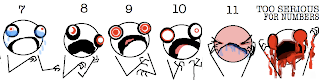
Which she interprets as:
I expect to see this written up in Pain shortly.
We're all familiar with the Wong-Baker Pain Faces Scale.
But as our Hyperbolic critic notes, this is easily misunderstood. For example, she interprets it as
0: Haha! I'm not wearing any pants!
2: Awesome! Someone just offered me a free hot dog!
4: Huh. I never knew that about giraffes.
6: I'm sorry about your cat, but can we talk about something else now? I'm bored.
8: The ice cream I bought barely has any cookie dough chunks in it. This is not what I expected and I am disappointed.
10: You hurt my feelings and now I'm crying!
Thus she has come up with a better scale:
Which she interprets as:
0: Hi. I am not experiencing any pain at all. I don't know why I'm even here.
1: I am completely unsure whether I am experiencing pain or itching or maybe I just have a bad taste in my mouth.
2: I probably just need a Band Aid.
3: This is distressing. I don't want this to be happening to me at all.
4: My pain is not fucking around.
5: Why is this happening to me??
6: Ow. Okay, my pain is super legit now.
7: I see Jesus coming for me and I'm scared.
8: I am experiencing a disturbing amount of pain. I might actually be dying. Please help.
9: I am almost definitely dying.
10: I am actively being mauled by a bear.
11: Blood is going to explode out of my face at any moment.
Too Serious For Numbers: You probably have ebola. It appears that you may also be suffering from Stigmata and/or pinkeye.
I expect to see this written up in Pain shortly.
14 March 2010
Mutations in the SCN9A gene and pain sensitivity
The article emphasizes the genetics, but I'm more interested in the implication that the heightened sensitivity relates to the speed at which sodium channels close in nociceptive neurons.
Gene Linked To Pain Perception - Science News: "Gene linked to pain perception
Common genetic variant makes some people more sensitive
By Laura Sanders
Web edition : Monday, March 8th, 2010
[....]
The team found that people who reported higher levels of pain were more likely to carry a particular DNA base, an A instead of a G, at a certain location in the gene SCN9A. The A version is found in an estimated 10 to 30 percent of people, Woods says, though its presence varies in populations of different ancestries.
[....]
The same trend — higher pain levels reported by people who carried the A — held true in cohorts of people with other painful conditions including sciatica, phantom limb syndrome and lumbar discectomy.
[....]
The genetic variation affects the structure of a protein that sits on the outside of nerve cells and allows sodium to enter upon painful stimuli. The sodium influx then spurs the nerve cell to send a pain message to the brain.
This channel protein is a promising target for extremely specific and effective pain drugs, Waxman says: ‘Given that this channel has been indicted, it would be nice if we could develop therapeutic handles that turn it off or down.’
Researchers already knew that people with mutations in SCN9A can have extreme pain syndromes. Genetic changes that render the protein completely inactive can leave a person impervious to pain, although otherwise healthy. Other mutations can lead to conditions such as ‘man on fire’ syndrome, in which people experience relentless, searing pain.
[....]
In additional laboratory studies, the researchers found that nerve cells carrying the A variant of the gene took longer to close their sodium gates, allowing a stronger pain signal to be sent to the brain. Nerve cells carrying the more common G version of the gene snapped shut faster, stopping the pain signal sooner. "
19 February 2010
Placebo effect video
Here's a nice summary of some of the current understanding of the placebo effect. I'm also a fan of the fact that the efficacy of a placebo pill increases with the geometric complexity of its shape.
Also, the point at the end about using the research on placebos is bolstered by research on the nocebo effect -where contextual cues make the condition worse (though the nocebo effect lacks much of the placebo effect's nuance).
Also, the point at the end about using the research on placebos is bolstered by research on the nocebo effect -where contextual cues make the condition worse (though the nocebo effect lacks much of the placebo effect's nuance).
17 February 2010
My mom must be proud
According to Alexa.com this site is the #1 place on the internet to find answers to the age old question:
Do opiates decrease telepathic abilities?I hope the 5 people arriving from 3 different countries found the answers they were looking for.
15 February 2010
Fetal pain
I think this sort of debate runs together two separate questions:
First, it's worth remembering that the aversiveness of pain is to some extent learned (see, for example, the famous McGill dog study). It might be that there is a pain sensation, but that the fetus has not learned to experience it as something bad. There might be evidence for or against this. But it probably wouldn't come from the fetus exhibiting near-reflex escape behaviors. IIRC, in adults many such behaviors are triggered very early in pain processing, even before much of the emotional processing occurs.
Second, there's the very hard question of whether fetuses are yet the sort of creatures that can have things be bad for them. Though I'm obsessed with the general problem (what makes something the subject of agent-relative value) I won't even try to articulate this one here. Especially because it actually a complex of several different super-hard issues.
(1) Is the neurophysiology upon which pain-involving mental states supervene present in fetuses of x weeks?and
(2) Is fetal pain --if it exists-- bad for the fetus?Here's two reasons for thinking they come apart.
First, it's worth remembering that the aversiveness of pain is to some extent learned (see, for example, the famous McGill dog study). It might be that there is a pain sensation, but that the fetus has not learned to experience it as something bad. There might be evidence for or against this. But it probably wouldn't come from the fetus exhibiting near-reflex escape behaviors. IIRC, in adults many such behaviors are triggered very early in pain processing, even before much of the emotional processing occurs.
Second, there's the very hard question of whether fetuses are yet the sort of creatures that can have things be bad for them. Though I'm obsessed with the general problem (what makes something the subject of agent-relative value) I won't even try to articulate this one here. Especially because it actually a complex of several different super-hard issues.
Omaha.com - The Omaha World-Herald: Metro/Region - When can fetus feel pain?: "Knowing when a fetus first feels pain is like many scientific endeavors: It involves speculation and disagreement.
A bill before the Nebraska Legislature, the Abortion Pain Prevention Act, would ban abortions 20 weeks after conception, because it's at that point, Speaker of the Legislature Mike Flood says, that a fetus begins to sense pain.
‘The science is compelling,’ the Norfolk lawmaker wrote on his Web site about the bill that is scheduled for a hearing Feb. 25.
In fact, there still is considerable disagreement among scientists, physicians and other experts. It's fairly common for a person's position on the question to mirror his position on abortion. But it's not clear when the complex communication circuitry in the body, spine and brain are developed enough for pain to be felt.
Nerve fibers designed to sense pain are present in a fetus's skin seven or eight weeks after conception, said Dr. Terence Zach, chairman of pediatrics at the Creighton University School of Medicine.
Surely by 20 weeks, Zach said, a fetus is mature enough to respond to what scientists call ‘noxious stimuli,’ or pain.
‘I believe that — yep,’ said Zach, who described himself as pro-life.
Another Omaha physician, Dr. Robert Bonebrake, agrees with Zach. Bonebrake, a perinatologist at Methodist Hospital, sometimes must give blood transfusions to fetuses or drain fluid from them at 21 or 22 weeks.
Those procedures involve inserting a needle or shunt into the fetus. Bonebrake said the fetus will ‘back away a little bit’ from the needle, indicating to him that it has felt the jab.
‘He or she will try to move away if possible,’ said Bonebrake, who also described himself as pro-life.
But in a review of fetal pain literature, University of California-San Francisco physicians reported in 2005 that ‘fetal perception of pain is unlikely before the third trimester,’ or about 27 weeks into the pregnancy.
The review, published in the Journal of the American Medical Association, said reflex movement isn't proof of pain, because it can occur without the brain being developed enough for conscious pain recognition.
The article also stated that only 1.4 percent of abortions in the U.S. occur at or after 21 weeks.
In Nebraska, fetal age doesn't have to be reported and usually isn't, according to a state health spokeswoman. But in cases where it was reported, none of the abortions that occurred in Nebraska in 2008 involved fetuses of 20 weeks or older.
The American College of Obstetricians and Gynecologists' position is that it ‘knows of no legitimate scientific information that supports the statement that a fetus experiences pain at 20 weeks' gestation.’
A Children's Hospital Boston anesthesiologist and researcher, Dr. Roland Brusseau, has studied the subject to determine whether a fetus undergoing a surgical procedure should have anesthesia. His institution is the main children's hospital of Harvard Medical School.
Brusseau calls discussions of fetal pain ‘complicated and controversial.’
He has suggested a broad timeline for when fetal pain might start: ‘If we are to accept that consciousness is possible by 20 weeks (or more conservatively, 30 weeks), then it also would appear possible that fetuses could experience something approximating ‘pain,'’ he wrote a little more than three years ago.
The possibility, he said, would appear to mandate the use of appropriate anesthesia when performing fetal surgery.
Federal legislation has been unsuccessfully introduced over the past several years to require abortion providers to inform the mother that the fetus could feel pain at 20 weeks and offer anesthesia directly to the fetus.
Six states — Oklahoma, Arkansas, Utah, Georgia, Louisiana and Minnesota — have passed similar legislation, according to the Center for Reproductive Rights in New York.
In Iowa, a bill to that effect in the Legislature failed in 2005.
What makes Flood's legislation different is that its answer to the question of fetal pain is to ban abortions after 20 weeks. Exceptions would be allowed if an abortion is deemed necessary to avoid substantial harm or death to the mother.
Flood said that laws protect animals in slaughterhouses from excessive pain, and that fetuses deserve that level of sensitivity.
He said he based his beliefs that fetuses feel pain at 20 weeks in part on assertions by Drs. Jean Wright and K.J.S. ‘Sunny’ Anand. Wright is former chairwoman of pediatrics at Mercer University School of Medicine's Savannah, Ga., campus and Anand is chief of pediatric critical care at the University of Tennessee Health Science Center.
Flood said experts have found, for instance, that stress hormones spike when fetuses undergo invasive procedures.
Wright couldn't be reached for comment, but Anand, who was reached while doing humanitarian work in Haiti, said fetuses show signs of sensory perception around 20 weeks.
‘Whether this happens at 20 weeks or 22 weeks or 18 weeks is still open to question,’ Anand said. Some fetuses might develop more quickly than others, he said.
Anand said he believes the sense of pain in a fetus isn't turned on like a light switch. ‘It's more like a dimmer switch that very slowly — very, very gradually — turns on particular sensory modalities.’
Anand said the chain of connections for pain perception includes nerve fibers, spinal cord circuitry, brain stem and other portions of the brain. It's impossible to know for sure whether a fetus feels pain, he said.
But denying there is pain, he said, means there's no incentive to study it, no reason to work out ways to anesthetize fetuses, and no need for a doctor to consider whether pain is being inflicted.
‘But I think the onus is on us to give the benefit of the doubt,’ he said.
Anand said he believes abortion is appropriate in some instances, such as if a teenager has been raped, and inappropriate in others, such as when a woman has broken up with a boyfriend and then learns she's pregnant.
Arthur Caplan, professor of medical ethics and director of the Center for Bioethics at the University of Pennsylvania, said that ‘on the whole, I don't think science and medicine can be drawn in to support’ Flood's bill.
Caplan, who has a doctorate in philosophy, called himself ‘a conservative pro-choicer.’ He said that there is no consensus among physicians and scientists on the subject of fetal pain and that the notion that pain is felt at 20 weeks is ‘not the mainstream opinion.’
Bellevue abortion provider Dr. LeRoy Carhart, who has said he will perform late-term abortions only in cases when the fetus can't survive outside the womb, said he doesn't believe there is fetal pain before or during his abortions.
Nevertheless, Carhart said when performing abortions in cases where the fetus is 17 weeks or older, he sedates the mother — which sedates the fetus — and then administers another injection to stop the fetus's heart. The abortion typically occurs 24 to 72 hours later, he said.
‘This should be the ‘Put Carhart Out of Business Bill,'’ he said of Legislative Bill 1103.
Flood denied that his bill was directed at Carhart's revenue and said: ‘Dr. Carhart's loss of business pales in comparison to the loss of young lives.’
Dr. Michael Barsoom, director of maternal-fetal medicine at the Creighton School of Medicine, said he has seen fetuses move away from needles when needles are put in or near them.
Whether that's a reaction to pain, though, is unclear, Barsoom said. The fetus might respond reflexively and not as a conscious pain experience, he said.
‘I honestly don't know,’ said Barsoom, who described himself as pro-life. He said he doesn't think anyone can say for sure when a fetus begins to feel pain.
‘I don't think there's any way to find out.’"
Oklahoma restricting injections for chronic pain
Unfortunately, the article doesn't say why this was an issue in the first place
Oklahoma House gets bill restricting injections for chronic pain | NewsOK.com: "
Only physicians would be allowed to administer precise pain management injections under a bill approved Tuesday by a House committee.
The House Public Health Committee approved Senate Bill 1133 by a 14-5 vote. It now goes to the full House.
Rep. John Trebilcock, who took over authorship of the bill, said pain management injections into a patient’s spinal or neck area must be precisely administered.
'Chronic pain medication is medicine and should be practiced by doctors,’ said Trebilcock, R-Broken Arrow.
The measure was carried over from last year after it failed to win passage. Efforts to come up with a compromise among a hospital group, doctors and certified registered nurse anesthetists fizzled. Certified registered nurse anesthetists now administer spinal injections to manage pain.
Trebilcock said the practice of chronic pain management is 'extremely dangerous.’
An injection in the wrong spot could cause paralysis or not effectively treat the pain, he said.
Trebilcock said certified nurse anesthetists would be allowed to continue to give other injections. It’s estimated the chronic pain injections take up only about 4 percent of their duties, he said.
Marvin York, a lobbyist for the Oklahoma Association of Nurse Anesthetists, said the measure would be a hardship to rural patients, because few rural doctors practice in pain management.
'I can’t imagine why any rural legislator ... could possibly be for this bill,’ he said.
Victor Long of Norman, a certified registered nurse anesthetist, said about 80 percent of the spinal injections for pain are administered by certified registered nurse anesthetists. About 500 certified registered nurse anesthetists are in the state, he said.
Rep. Pat Ownbey, R-Ardmore, said he wondered why the bill was necessary because no complaints had been filed against certified registered nurse anesthetists administering chronic pain management injections.
'Is this a patient issue or a money issue?’ he asked fellow committee members. 'Make no mistake, this is a turf war.’
Trebilcock said doctors are willing to travel to rural areas to administer the injections.
'Rural Oklahoma shouldn’t have to settle for less than a doctor when they suffer from chronic pain,’ he said."
14 February 2010
Healthcare-Associated Infection
This isn't directly about pain. But I thought I'd pass it along.
The Kimberly-Clark Health Care Company has an informational (and of course promotional) website on healthcare associated infections here Patients who want to get a sense of the problem and what they should keep an eye out for may find some of the links useful.
06 February 2010
Anguish
Thanks OED:
[a. OFr. anguisse, angoisse (Pr. angoissa, It. angoscia) the painful sensation of choking:{em}L. angustia straitness, tightness, pl. straits, f. angust-us narrow, tight, f. root angu- in ang(u)-{ebreve}re to squeeze, strangle, cogn. w. Gr. {alenisacu}{gamma}{chi}-{epsilon}{iota}{nu}.]
Formerly with pl.
1. Excruciating or oppressive bodily pain or suffering, such as the sufferer writhes under.
c1220 Hali Meid. 35 Hwen hit {th}er to cume{edh} {th}at sar sorhfule angoise. a1300 Pop. Sc. (Wright) 374 The bodi..in strong angusse doth smurte. c1380 Sir Ferumb. 212 Hys wounde..for angwys gan to chyne. 1382 WYCLIF Jer. iv. 31 Anguysshes as of the child berere [1388 angwischis as of a womman childynge; 1611 the anguish as of her that bringeth forth her first child]. c1386 CHAUCER Pars. T. 139 The peyne of helle..is lik deth, for the horrible anguisshe [v.r. angwissh(e, -uysch, -uyssche, -wysshe]. 1485 CAXTON Chas. Gt. 238, I haue suffred many anguysshes of hungre. 1592 SHAKES. Rom. & Jul. I. ii. 47 One paine is lesned by anothers anguish. 1656 RIDGLEY Pract. Physick 150 If there be pain of the Stomach, anguish, heat. 1758 S. HAYWARD Serm. xvii. 520 His [Job's] body was full of anguish. 1880 CYPLES Hum. Exp. iii. 70 The anguish of corns and toothache.
2. Severe mental suffering, excruciating or oppressive grief or distress.
c1230 Ancr. R. 234 In the muchel anguise aros {th}e muchele mede. 1297 R. GLOUC. 177 In gret anguysse and fere Wepynde byuore {th}e kyng. c1325 E.E. Allit. P. C. 325 When {th}acces of anguych wat{ygh} hid in my sawle. 1382 WYCLIF Prov. xxi. 23 Who kepeth his mouth and his tunge, kepeth his soule fro anguysschis. c1450 Merlin 64 Grete angwysshe that he suffred for the love of Ygerne. 1583 STANYHURST Aeneis II. (Arb.) 46 With choloricque fretting I dumpt, and ranckled in anguish. 1611 BIBLE Job vii. 11, I wil speake in the anguish of my spirit. 1678 JENKINS in Pepys VI. 125 An honest man..full of Anguishes for his King and his Country. 1769 Junius Lett. xxiii. 105 You may see with anguish how much..authority you have lost. 1810 SCOTT Lady of L. II. xxxiv, The deep anguish of despair.
[a. OFr. anguisse, angoisse (Pr. angoissa, It. angoscia) the painful sensation of choking:{em}L. angustia straitness, tightness, pl. straits, f. angust-us narrow, tight, f. root angu- in ang(u)-{ebreve}re to squeeze, strangle, cogn. w. Gr. {alenisacu}{gamma}{chi}-{epsilon}{iota}{nu}.]
Formerly with pl.
1. Excruciating or oppressive bodily pain or suffering, such as the sufferer writhes under.
c1220 Hali Meid. 35 Hwen hit {th}er to cume{edh} {th}at sar sorhfule angoise. a1300 Pop. Sc. (Wright) 374 The bodi..in strong angusse doth smurte. c1380 Sir Ferumb. 212 Hys wounde..for angwys gan to chyne. 1382 WYCLIF Jer. iv. 31 Anguysshes as of the child berere [1388 angwischis as of a womman childynge; 1611 the anguish as of her that bringeth forth her first child]. c1386 CHAUCER Pars. T. 139 The peyne of helle..is lik deth, for the horrible anguisshe [v.r. angwissh(e, -uysch, -uyssche, -wysshe]. 1485 CAXTON Chas. Gt. 238, I haue suffred many anguysshes of hungre. 1592 SHAKES. Rom. & Jul. I. ii. 47 One paine is lesned by anothers anguish. 1656 RIDGLEY Pract. Physick 150 If there be pain of the Stomach, anguish, heat. 1758 S. HAYWARD Serm. xvii. 520 His [Job's] body was full of anguish. 1880 CYPLES Hum. Exp. iii. 70 The anguish of corns and toothache.
2. Severe mental suffering, excruciating or oppressive grief or distress.
c1230 Ancr. R. 234 In the muchel anguise aros {th}e muchele mede. 1297 R. GLOUC. 177 In gret anguysse and fere Wepynde byuore {th}e kyng. c1325 E.E. Allit. P. C. 325 When {th}acces of anguych wat{ygh} hid in my sawle. 1382 WYCLIF Prov. xxi. 23 Who kepeth his mouth and his tunge, kepeth his soule fro anguysschis. c1450 Merlin 64 Grete angwysshe that he suffred for the love of Ygerne. 1583 STANYHURST Aeneis II. (Arb.) 46 With choloricque fretting I dumpt, and ranckled in anguish. 1611 BIBLE Job vii. 11, I wil speake in the anguish of my spirit. 1678 JENKINS in Pepys VI. 125 An honest man..full of Anguishes for his King and his Country. 1769 Junius Lett. xxiii. 105 You may see with anguish how much..authority you have lost. 1810 SCOTT Lady of L. II. xxxiv, The deep anguish of despair.
25 January 2010
Man experiences intense pain from nail that slid between his toes Boing Boing
There are some experiments in which subjects primed to expect pain experience pain when given an ambiguous stimulus (e.g., a rapidly vibrating emery board). But this is much cooler:
H/T: Saba
Man experiences intense pain from nail that slid between his toes Boing Boing: ""
Mind Hacks reports that a nail penetrated the shoe of a 29-year-old construction worker, causing great pain. But the hospital workers discovered that the nail had passed harmlessly between his toes.
A builder aged 29 came to the accident and emergency department having jumped down on to a 15 cm nail. As the smallest movement of the nail was painful he was sedated with fentanyl and midazolam. The nail was then pulled out from below. When his boot was removed a miraculous cure appeared to have taken place. Despite entering proximal to the steel toecap the nail had penetrated between the toes: the foot was entirely uninjured.
Mind Hacks says this is related to "somatisation disorder, where physical symptoms appear that aren't explained by tissue damage."
H/T: Saba
Does Morphine Stimulate Cancer Growth?
No.
GeriPal does yeoman's work in explaining why
Does Morphine Stimulate Cancer Growth? | GeriPal - A Geriatrics and Palliative Care Blog: ""
31 December 2009
TENS confusion
Given that TENS was part of the discovery of the gate-control theory 40 years ago, it really would be nice if its implications for the distinction between nociception and pain had seeped in. This is from a press release on Science Daily:
How about:
That's still inaccurate. But it at least avoids framing the phenomenon as the system stopping the pain before it gets to the brain. Getting people used to distinguishing between nociception and pain is a small but important step in a better public understanding of analgesia and chronic pain conditions.
Widely used device for pain therapy not recommended for chronic low back pain A new guideline issued by the American Academy of Neurology finds that transcutaneous electric nerve stimulation (TENS), a widely used pain therapy involving a portable device, is not recommended to treat chronic low-back pain that has persisted for three months or longer because research shows it is not effective.... TENS can be effective in treating diabetic nerve pain, also called diabetic neuropathy, but more and better research is needed to compare TENS to other treatments for this type of pain. Research on TENS for chronic low-back pain has produced conflicting results. For the guideline, the authors reviewed all of the evidence for low-back pain lasting three months or longer. Acute low-back pain was not studied. The studies to date show that TENS does not help with chronic low-back pain.So far so good. But then in the nickel summary of what TENS is they write:
With TENS, a portable, pocket-sized unit applies a mild electrical current to the nerves through electrodes. TENS has been used for pain relief in various disorders for years. Researchers do not know how TENS may provide relief for pain. One theory is that nerves can only carry one signal at a time. The TENS stimulation may confuse the brain and block the real pain signal from getting through.
How about:
Neural signals reporting injury have to pass through a gate in the spine in order to be transmitted to the brain and cause pain. The electric impulse from TENS closes the gate.
That's still inaccurate. But it at least avoids framing the phenomenon as the system stopping the pain before it gets to the brain. Getting people used to distinguishing between nociception and pain is a small but important step in a better public understanding of analgesia and chronic pain conditions.
11 December 2009
Acetaminophen-Related Liver Damage May Be Prevented By Common Herbal Medicine
Perhaps I can slacken my anti-acetaminopen stance* a bit....
*I don't doubt its usefulness for many conditions. What I don't like is how it's seen/promoted/prescribed as something benign by consumers/companies and drug stores/doctors.
Acetaminophen-Related Liver Damage May Be Prevented By Common Herbal Medicine: "Acetaminophen-Related Liver Damage May Be Prevented By Common Herbal Medicine
A well-known Eastern medicine supplement may help avoid the most common cause of liver transplantation, according to a study by researchers at the Stanford University School of Medicine. The finding came as a surprise to the scientists, who used a number of advanced genetic and genomic techniques in mice to identify a molecular pathway that counters acetaminophen toxicity, which leads to liver failure.
'I didn't know anything about the substance that was necessary for the pathway's function, so I had to look it up,' said Gary Peltz, MD, PhD, professor of anesthesiology. 'My postdoctoral fellow, whose parents and other family members in Asia were taking this compound in their supplements, started laughing. He recognized it immediately.'
The molecule was S-methylmethionine, which had been marketed as an herbal medicine known as Vitamin U for treatment of the digestive system. It is highly abundant in many plants, including cabbage and wheat, and is routinely ingested by people. [...]
Peltz is the senior author of the research, which will be published online Nov. 18 in Genome Research. The experiments were conducted in Peltz's laboratory at Roche Palo Alto in Palo Alto, Calif., where Peltz worked before coming to Stanford in July 2008. He is continuing the research at Stanford. The first author of the paper, Hong-Hsing Liu, MD, PhD, is now a postdoctoral scholar in Peltz's Stanford lab.
Acetaminophen is a pain reliever present in many over-the-counter cold and flu medicines. It is broken down, or metabolized, in the body into byproducts - one of which can be very toxic to the liver. At normal, therapeutic levels, this byproduct is easily deactivated when it binds to a naturally occurring, protective molecule called glutathione. But the body's glutathione stores are finite, and are quickly depleted when the recommended doses of acetaminophen are exceeded.
Unfortunately, the prevalence of acetaminophen makes it easy to accidentally exceed the recommended levels, which can occur by dosing more frequently than indicated or by combining two or more acetaminophen-containing products. However, severe liver damage can occur at even two to three times the recommended dose (the maximum adult dose is 4 grams per day; toxic daily levels range from 7 to 10 grams).
'It's a huge public health problem,' said Peltz. 'It's particularly difficult for parents, who may not realize that acetaminophen is in so many pediatric medicines.' Acetaminophen overdose is the most common cause of liver transplantation in this country. The only effective antidote is an unpalatable compound called NAC that can induce nausea and vomiting, and must be administered as soon as possible after the overdose.
Peltz and his colleagues used 16 inbred strains of laboratory mice for their investigations. Most strains are susceptible to acetaminophen toxicity, but one is resistant. They compared how the drug is metabolized by the different strains and looked for variations in gene expression and changes in endogenous metabolites in response to acetaminophen administration. They identified 224 candidate genes that might explain the resistant strain's ability to ward off liver damage, and then plumbed computer databases to identify those involved in metabolizing acetaminophen's dangerous byproducts.
One, an enzyme called Bhmt2, fit the bill: It helped generate more glutathione, and its sequence varied between the resistant and non-resistant strains of mice. Bhmt2 works by converting the diet-derived molecule S-methylmethionine, or SMM, into methionine, which is subsequently converted in a series of steps into glutathione. The researchers confirmed the importance of the pathway by showing that SMM conferred protection against acetaminophen-induced liver toxicity only in strains of mice in which the Bhmt2 pathway was functional.
'By administering SMM, which is found in every flowering plant and vegetable, we were able to prevent a lot of the drug's toxic effect,' said Peltz. He and his colleagues are now working to set up clinical trials at Stanford to see whether it will have a similar effect in humans. In the meantime, though, he cautions against assuming that dosing oneself with SMM will protect against acetaminophen overdose.
'There are many pathways involved in the metabolism of this drug, and individuals' genetic backgrounds are tremendously variable. This is just one piece of the puzzle; we don't have the full answer,' he said. However, if subsequent studies are promising, Peltz envisions possibly a co-formulated drug containing both acetaminophen and SMM or using SMM as a routine dietary supplement."
*I don't doubt its usefulness for many conditions. What I don't like is how it's seen/promoted/prescribed as something benign by consumers/companies and drug stores/doctors.
Antidepressants, CYP2D6, and opioid metabolism
Awhile back I posted this bleg for more information about the interaction between antidepressants and codeine. Peter Nelson emailed me asking whether I had found out anything else. I hadn't, so he did some research of his own which he has kindly agreed to allow me to share.
Take it away, Peter:
[Usual disclaimer: Neither he nor I are medical professionals. Don't take this as medical advice, et cetera.]
Since emailing you I’ve been studying the research literature and it’s crystal clear that codeine will not have any analgesic properties for people either genetically lacking CYP2D6 (6-10% of caucasians, other %’s for other ethnic groups) or who are taking a drug that blocks it.
Many antidepressants, including fluoxetine, paroxetine and bupropion are strong inhibitors of it, as are many other drugs including various antiarrhythmics, antifungals, cancer drugs, etc.
The story on the other synthetic opioids doesn’t look too good either. CYP2D6 plays a critical role in the metabolism of hydrocodone, oxycodone, and tramadol but they have more complex metabolic pathways and even now there are details that remain to be elucidated.
Hydrocodone itself has little affinity for the μ opioid (pain) receptors so it has to get metabolized the main clinically-active metabolite is assumed to be hydromorphone because it’s a known painkiller with a high affinity for the μ opioid receptors. And lack of CYP2D6 blocks that process. That part is clear, but there are unanswered questions.
For example in Kaplan et al, (Inhibition of cytochrome P450 2D6 metabolism of hydrocodone to hydromorphone does not importantly affect abuse liability J Pharmacol Exp Ther. 1997 Apr;281(1):103-8) subjects’ subjective perception of the effects of hydrocodone were unrelated to hydromorphone conversion. Heiskanen et al, (Effects of blocking CYP2D6 on the pharmacokinetics and pharmacodynamics of oxycodone. Clin Pharmacol Ther. 1998 Dec;64(6):603-11. ) performed a similar experiment involving oxycodone with similar results.
But critically, neither experiment looked at pain tolerance. Also Otton et al, (CYP2D6 phenotype determines the metabolic conversion of hydrocodone to hydromorphone - SV - Clin Pharmacol Ther - 01-NOV-1993; 54(5):) performed an experiment similar to Kaplan’s but did find that subjects responded in ways consisten with hydromorphone conversion (again, no pain test).
Based on what we think we know about hydrocodone (i.e., that the active metabolite is hydromorphone), Otton’s results make more sense. But both hydrocodone and oxycodone still have work left to do elucidating the effects of some of the other metabolites that are currently thought to be inactive.
And Heiskanen’s results also make sense because oxycodone – the parent compound - actually appears to have a nontrivial affinity for μ receptors itself, and furthermore some of its other metabolites such as noroxycodone, which may be mediated by a different enzyme – CYP2C19 - may also have high binding affinity. (Lalovic et al, Quantitative contribution of CYP2D6 and CYP3A to oxycodone metabolism in human liver and intestinal microsomes. Drug Metab Dispos. 2004 Apr;32(4):447-54. )
In other words oxycodone may work fine as an analgesic for CYP2D6 impaired patients. BUT that doesn’t mean oxycodone gets us off the hook - instead it appears to have a nastier hook: The oxymorhone is far more readily cleared than the parent compound oxycodone. So without CYP2D6 oxycodone accumulates, potentially becoming toxic or fatal.
Two studies underscore that risk: Jannetto, et al, Pharmacogenomics as molecular autopsy for postmortem forensic toxicology; genotyping cytochrome P450 2D6 for oxycodone cases. J Anal Toxicol 2002; 26:438–447 and Drummer et al, A study of deaths involving oxycodone. J Forensic Sci 1994; 39:1069–1075.
The real bottom lines are these:
Visit Peter's blog at http://blog.pnart.com/. Thanks again!
Take it away, Peter:
[Usual disclaimer: Neither he nor I are medical professionals. Don't take this as medical advice, et cetera.]
Since emailing you I’ve been studying the research literature and it’s crystal clear that codeine will not have any analgesic properties for people either genetically lacking CYP2D6 (6-10% of caucasians, other %’s for other ethnic groups) or who are taking a drug that blocks it.
Many antidepressants, including fluoxetine, paroxetine and bupropion are strong inhibitors of it, as are many other drugs including various antiarrhythmics, antifungals, cancer drugs, etc.
The story on the other synthetic opioids doesn’t look too good either. CYP2D6 plays a critical role in the metabolism of hydrocodone, oxycodone, and tramadol but they have more complex metabolic pathways and even now there are details that remain to be elucidated.
Hydrocodone itself has little affinity for the μ opioid (pain) receptors so it has to get metabolized the main clinically-active metabolite is assumed to be hydromorphone because it’s a known painkiller with a high affinity for the μ opioid receptors. And lack of CYP2D6 blocks that process. That part is clear, but there are unanswered questions.
For example in Kaplan et al, (Inhibition of cytochrome P450 2D6 metabolism of hydrocodone to hydromorphone does not importantly affect abuse liability J Pharmacol Exp Ther. 1997 Apr;281(1):103-8) subjects’ subjective perception of the effects of hydrocodone were unrelated to hydromorphone conversion. Heiskanen et al, (Effects of blocking CYP2D6 on the pharmacokinetics and pharmacodynamics of oxycodone. Clin Pharmacol Ther. 1998 Dec;64(6):603-11. ) performed a similar experiment involving oxycodone with similar results.
But critically, neither experiment looked at pain tolerance. Also Otton et al, (CYP2D6 phenotype determines the metabolic conversion of hydrocodone to hydromorphone - SV - Clin Pharmacol Ther - 01-NOV-1993; 54(5):) performed an experiment similar to Kaplan’s but did find that subjects responded in ways consisten with hydromorphone conversion (again, no pain test).
Based on what we think we know about hydrocodone (i.e., that the active metabolite is hydromorphone), Otton’s results make more sense. But both hydrocodone and oxycodone still have work left to do elucidating the effects of some of the other metabolites that are currently thought to be inactive.
And Heiskanen’s results also make sense because oxycodone – the parent compound - actually appears to have a nontrivial affinity for μ receptors itself, and furthermore some of its other metabolites such as noroxycodone, which may be mediated by a different enzyme – CYP2C19 - may also have high binding affinity. (Lalovic et al, Quantitative contribution of CYP2D6 and CYP3A to oxycodone metabolism in human liver and intestinal microsomes. Drug Metab Dispos. 2004 Apr;32(4):447-54. )
In other words oxycodone may work fine as an analgesic for CYP2D6 impaired patients. BUT that doesn’t mean oxycodone gets us off the hook - instead it appears to have a nastier hook: The oxymorhone is far more readily cleared than the parent compound oxycodone. So without CYP2D6 oxycodone accumulates, potentially becoming toxic or fatal.
Two studies underscore that risk: Jannetto, et al, Pharmacogenomics as molecular autopsy for postmortem forensic toxicology; genotyping cytochrome P450 2D6 for oxycodone cases. J Anal Toxicol 2002; 26:438–447 and Drummer et al, A study of deaths involving oxycodone. J Forensic Sci 1994; 39:1069–1075.
The real bottom lines are these:
1. Work remains to be done in elucidating both the pharmacokinetics and clinical effects of various metabolites for all of the synthetic opioids.
2. As far as I could tell, there seem to be no human studies evaluating analgesic properties of synthetic opioids for patients who either lack the gene for CYP2D6 or for whom CYP2D6 is blocked by a drug-drug interaction.
3. Drug-drug interactions of this type will become more common as the population becomes older and as we use a greater variety of drugs. As it is, bupropion. paroxetine and fluoxetine (all potent CYP2D6 blockers) accounted for roughly 50 million prescriptions in the US alone last year. Other CYP2D6 blockers account for millions more.
4. I’ve spoken to several physicians about this and they all expressed worry and concern that they feel unsure how to do pain management for CYP2D6-impaired patients, especially in postoperative or fracture cases where OTC drugs aren’t enough and the “nuclear options” like fentanyl or methadone (both of which work regardless of CYP2D6) would be overkill and dangerous.
Visit Peter's blog at http://blog.pnart.com/. Thanks again!
12 November 2009
What's bad about masochistic pain?
Here's the video from the talk I gave back in April about whether masochistic pain is good:
Warning: This is totally unsafe for work, and most definitely not for the squeamish. The talk proper may cause mild reactions in those allergic to analytic philosophy. Such reactions are less common with the discussion alone.
http://www.adamswenson.net/HSG/HSG1.htmlBut since it's just me reading the paper aloud, you'll probably want to skip ahead and just watch the discussion:
Part 1 http://www.adamswenson.net/HSG/HSG2.htmlThe paper and powerpoint slides are available on the website.
Part 2 http://www.adamswenson.net/HSG/HSG3.html
Warning: This is totally unsafe for work, and most definitely not for the squeamish. The talk proper may cause mild reactions in those allergic to analytic philosophy. Such reactions are less common with the discussion alone.
08 November 2009
Children Can Greatly Reduce Abdominal Pain By Using Their Imagination: UNC Study
Children Can Greatly Reduce Abdominal Pain By Using Their Imagination: UNC Study: "
Children with functional abdominal pain who used audio recordings of guided imagery at home in addition to standard medical treatment were almost three times as likely to improve their pain problem, compared to children who received standard treatment alone.
And those benefits were maintained six months after treatment ended
[....]
The study focused on functional abdominal pain, defined as persistent pain with no identifiable underlying disease that interferes with activities. It is very common, affecting up to 20 percent of children. Prior studies have found that behavioral therapy and guided imagery (a treatment method similar to self-hypnosis) are effective, when combined with regular medical care, to reduce pain and improve quality of life.
[....]
In the group that used guided imagery, the children reported that the CDs were easy and enjoyable to use. In that group, 73.3 percent reported that their abdominal pain was reduced by half or more by the end of the treatment course. Only 26.7 percent in the standard medical care only group achieved the same level of improvement. This increased to 58.3 percent when guided imagery treatment was offered later to the standard medical care only group. In both groups combined, these benefits persisted for six months in 62.5 percent of the children.
"
Acetaminophen May Be Linked To Asthma In Children And Adults
More reason to stay away as much as possible....
Acetaminophen May Be Linked To Asthma In Children And Adults: "New research shows that the widely used pain reliever acetaminophen may be associated with an increased risk of asthma and wheezing in both children and adults exposed to the drug. Researchers from the University of British Columbia, Vancouver, BC, Canada, conducted a systematic review and metaanalysis of 19 clinical studies (total subjects=425,140) that compared the risk of asthma or wheezing with acetaminophen exposure.
The analysis showed that the pooled odds ratio (odds ratio for all studies combined) for asthma among users of acetaminophen was 1.63. The risk of asthma in children who used acetaminophen in the year prior to asthma diagnosis or in the first year of life was elevated to 1.60 and 1.47, respectively.
Furthermore, results showed a slight increase in the risk of asthma and wheezing with prenatal use of acetaminophen by mothers. Researchers speculate that acetaminophen's lack of inhibition of cyclooxygenase, the key enzyme involved in the inflammatory response of asthma, may be one explanation for the potential link between acetaminophen use and asthma. "
04 November 2009
22 October 2009
Bandolier Evidence-Based guides
Turns out my favorite Little Book of Pain (no joke: that's the title) has a bunch of evidence-based reviews of all sorts of pain-related topics. The main site is here:
Here are some examples
Other general pain control stuff
Palliative and supportive care
Pain care before, during, and after operations
Dysmenorrhoea (menstrual cramps)
Here are some examples
Other general pain control stuff
Palliative and supportive care
Pain care before, during, and after operations
Dysmenorrhoea (menstrual cramps)
18 September 2009
Why papercuts hurt so damn much
During my bimonthly rereading of Price's Psychological Mechanisms of Pain and Analgesia, I ran across this in the middle of a discussion of the relationship between tissue damage and pain intensity:
the rate of tissue damage is a direct function of protein in activation that, in turn, is a function of temperature. However, the amount of tissue damage is a function of both skin temperature and duration of stimulation. Since heat-induced pain depends only on the temperature attained by the cells of the skin and on duration of stimulation, pain intensity follows the rate of tissue damage and not its total amount. One consequence of this phenomenon is that some extensive wounds may be less painful than slight wounds. Pain from tissues that have suddenly become inflamed, such as a toothache, is an example." [Page 11; italics original]
A role for glial cell-targeting treatments for pain?
The Psychology of Pain blog links to an interesting new study from CU-Boulder. I don't want to steal too much of his post, so here's a tease:
But, like Gremlins, they have a nasty side too
Under normal circumstances glial cells are thought to be like housekeepers, said Watkins. They essentially clean up debris and provide support for neurons.
But, like Gremlins, they have a nasty side too
[the researchers] believe they have figured out how morphine affects glial cells and neurons. 'We've found that different receptors are involved in how morphine suppresses pain through its actions on neurons versus how morphine activates glial cells,' Watkins said. 'What this means is that you should be able to separate the suppressive effects of morphine -- its pain-reducing effects through its action on neurons -- from all of its bad effects when it excites glial cells.'
(Via Psychology of Pain.)
19 August 2009
More sting connoisseurship
Here's a nice little interview vignette with Justin Schmidt whose 'Justin O. Schmidt's 'Sting Pain Index' I've mentioned before.
On reflection, it is quite funny how much power a drop of venom gives a little tiny bug over us:
At least, its funny when a harvester ant whose sting “felt like somebody was putting a knife in and twisting it” makes the point. Less so, when it comes from sterner teachers
On reflection, it is quite funny how much power a drop of venom gives a little tiny bug over us:
Oh, Sting, Where Is Thy Death? - Happy Days Blog - NYTimes.com: The pain index came into being, he said, because he wanted to understand the two ways stinging can be of defensive value to an insect. ‘One is that it can actually do serious damage, to kill the target or make it impaired. The other is the whammy, the pain.’ He could quantify the amount of venom injected and its toxicity, but he had no way to measure pain other than through direct experience. So the pain index gave him a tool for interpreting an insect’s overall defensive strategy.
In fact, most insect stings do no damage at all, except to the two percent of people who suffer an allergic reaction. They just scare the wits out of us. And this is why they fascinate Schmidt: We typically outweigh any insect tormentor by a million times or more. We can outthink it. ‘And yet it wins,’ said Schmidt, ‘and the evidence that it has won is that people flap their arms, run around screaming, and do all kinds of carrying on.’ It wins ‘by making us hurt far more than any animal that size ought to be able to do. It deceives us into thinking serious damage is being done.’ And that’s generally enough to deliver the insect’s message, which is: Stay away from me and my nest."
At least, its funny when a harvester ant whose sting “felt like somebody was putting a knife in and twisting it” makes the point. Less so, when it comes from sterner teachers
A wasp known in the American Southwest as the “tarantula hawk” made him lie down and scream: “The good news is that by three minutes, it’s gone. If you really use your imagination you can get it to last five.” On the other hand, the sting of a bullet ant in Brazil (4-plus on the pain index) had him “still quivering and screaming from these peristaltic waves of pain” twelve hours later, despite the effects of ice compresses and beer.
Redheads need more drugs
Huh.
It's also nice to hear that the research came from taking this sort of common experience seriously, rather than simply dismissing it:
If I had red hair, I would bring a copy of the paper with me to the dentist/doctor to help them take my needs seriously.*
*Just as I would, for example, show literature on the usefulness of pre-incision lidocaine in lowering post-surgicial pain to my surgeon.
I might also post articles on the problems with using morphine in patients with kidney problems on the wall by an elderly relative's hospital bed.
The Pain of Being a Redhead - Well Blog - NYTimes.com:
A growing body of research shows that people with red hair need larger doses of anesthesia and often are resistant to local pain blockers like Novocaine. As a result, redheads tend to be particularly nervous about dental procedures and are twice as likely to avoid going to the dentist as people with other hair colors, according to new research published in The Journal of the American Dental Association.
Researchers believe redheads are more sensitive to pain because of a mutation in a gene that affects hair color. In people with brown, black and blond hair, the gene, for the melanocortin-1 receptor, produces melanin. But a mutation in the MC1R gene results in the production of a substance called pheomelanin that results in red hair and fair skin.
The MC1R gene belongs to a family of receptors that include pain receptors in the brain, and as a result, a mutation in the gene appears to influence the body’s sensitivity to pain. A 2004 study showed that redheads require, on average, about 20 percent more general anesthesia than people with dark hair or blond coloring. And in 2005, researchers found that redheads are more resistant to the effects of local anesthesia, such as the numbing drugs used by dentists.
[....]
It's also nice to hear that the research came from taking this sort of common experience seriously, rather than simply dismissing it:
Dr. Daniel I. Sessler, an anesthesiologist and chairman of the department of outcomes research at the Cleveland Clinic, said he began studying hair color after hearing so many colleagues speculate about redheads requiring more anesthesia.
‘The reason we studied redheads in the beginning, it was essentially an urban legend in the anesthesia community saying redheads were difficult to anesthetize,’ Dr. Sessler said. ‘This was so intriguing we went ahead and studied it. Redheads really do require more anesthesia, and by a clinically important amount.’
If I had red hair, I would bring a copy of the paper with me to the dentist/doctor to help them take my needs seriously.*
*Just as I would, for example, show literature on the usefulness of pre-incision lidocaine in lowering post-surgicial pain to my surgeon.
I might also post articles on the problems with using morphine in patients with kidney problems on the wall by an elderly relative's hospital bed.
Methadone prescribers' network
The astonishing recent rise in opioid overdoses (many involving methadone) has finally forced me to agree that our (at least in the US) opioid policies and practices need some revision. Thus this expansion of a program available to buprenorphine prescribers seems welcome.
As a general rule, I think drug policy should (strongly) promote the responsible clinician's ability to prescribe opioids as she sees fit . So, insofar as this sort of program can help stem diversion and accidental overdose, I'd much rather see more of these than more restrictive drug policies.
A New Service For Health Care Providers Who Prescribe Methadone To Treat Chronic Pain Or Opioid Addiction: "
A new service for health care providers prescribing methadone to treat chronic pain or opioid addiction -- the Physician Clinical Support System for Methadone (PCCS-M) -- opens this week with a mechanism to connect prescribers of methadone with experienced clinicians for one-to-one mentoring regarding the use of this medication.
Methadone is an inexpensive opioid medication that has several unique properties that make it particularly well suited to the treatment of chronic pain or opioid addiction, but it also has side effects and the potential for overdose and requires specific information for its proper use.
The new service is one in a number of federally-funded projects that address the need within the nation's health care system to provide safe and effective care of patients with chronic pain and opioid addiction while, at the same time, protecting the public from prescription drug abuse and diversion of medications. Using this new service, prescribers can contact a mentor, a knowledgeable colleague, by phone or e-mail with specific questions about the use of methadone for treating chronic pain or opioid addiction.
Source: American Society of Addiction Medicine "
As a general rule, I think drug policy should (strongly) promote the responsible clinician's ability to prescribe opioids as she sees fit . So, insofar as this sort of program can help stem diversion and accidental overdose, I'd much rather see more of these than more restrictive drug policies.
15 August 2009
Coral for neuropathic pain
Not as cool as sea-snail venom, but still worth filing under 'cool things from the sea'
New Hope Of Relief For Neuropathic Pain: "New Hope Of Relief For Neuropathic Pain
A compound initially isolated from a soft coral (Capnella imbricata) collected at Green Island off Taiwan, could lead scientists to develop a new set of treatments for neuropathic pain - chronic pain that sometimes follows damage to the nervous system.
[....]
Recent research suggests inflammation in the nervous system is a major causative factor for this condition. Inflammation activates supporting cells, such as microglia and astrocytes, that surround the nerve cells. These activated cells release compounds called cytokines that can excite nerves carrying pain sensation (nociceptive pathways) and cause the person to experience mildly uncomfortable stimuli as very painful (hyperalgesia), or stimuli that would normally induce no discomfort at all as painful (allodynia). Thus, cold drafts or lightly brushing the skin can produce intense pain, severely affecting the person's quality of life.
[....]
Although the chemical they studied, capnellene, was originally isolated in 1974, it is only recently that scientists have started to appreciate its potential. Capnellene is interesting because its structure is very different from pain-relieving drugs currently in use. Initial experiments suggested that it may have pain-relieving properties. Working with Yen-Hsuan Jean MD, PhD and other colleagues, Dr Wen tested capnellene and a second very similar compound, in isolated microglial cells and in experimental models of the condition in rats.
They found that the compounds significantly reduced pain-related activities in isolated microglia, and that these compounds also significantly reversed hyperalgesic behaviour in the experimental rats.
"
Subscribe to:
Posts (Atom)
